Ibrahim Mahama. Le Temps des récoltes
Fondation Cartier pour l'art contemporain
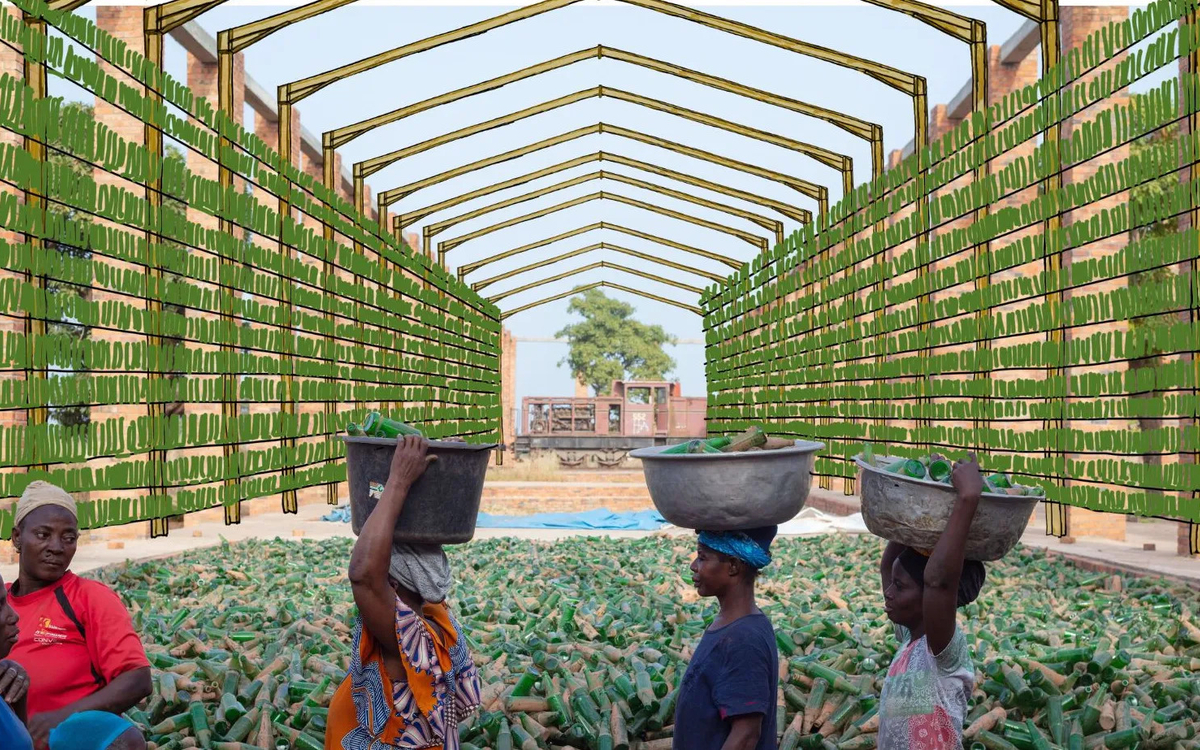
In fall 2026, the Fondation Cartier pour l'art contemporain presents Le Temps des récoltes, an exhibition of unprecedented scale in France by the Ghanaian artist Ibrahim Mahama, accompanied by nine associated artists: Dorothy Akpene Amenuke, Gideon Appah, James Barnor, Cercle d'Art des Travailleurs de Plantation Congolaise (CATPC), Courage Dzidula Kpodo, Zohra Opoku, Postbox Ghana, Tjaša Rener, Feda Wardak. Ibrahim Mahama imagines for the Fondation Cartier a living entity resonating with the art centers he founded in Tamale, in northern Ghana. Together with the associated artists, he occupies the entirety of the institution's spaces, place du Palais-Royal, with works created specifically for the site, as well as new versions of some of his emblematic installations. Since its creation, the Fondation Cartier has established itself as a space for dialogue, experimentation and artistic exploration attentive to the emerging centers of contemporary creation and the voices that traverse it. As early as the 1990s, it played a pioneering role in presenting artists from the African continent, such as Seydou Keïta, Bodys Isek Kingelez, Malick Sidibé, J. D. 'Okhai Ojeikere or Chéri Samba. Le Temps des récoltes, Ibrahim Mahama's first Parisian exhibition, which brings together nine artists and collectives for the occasion, follows in this continuity. Ibrahim Mahama (born in 1987 in Tamale, Ghana) has established himself on the international scene through his installations made from collected materials, archives and fragments of industrial heritage that he reactivates to shape new imaginaries. Since the 2010s, he has developed a body of work founded on the exploration of Ghana's colonial and postcolonial legacies. Drawing on his country's industrial and commercial history, he questions the circulation of goods, the transmission of know-how and the preservation of heritage. His work sheds light on political, social and economic continuities and ruptures, paying particular attention to infrastructures, traces of the past and collective dynamics. Conceived by Ibrahim Mahama with nine artists and collectives, all connected to him through long-standing collaborations, research or exchanges, the exhibition Le Temps des récoltes is a direct extension of this approach. It echoes the three art centers founded by the artist in Tamale, in northern Ghana, since 2019. Conceived as spaces for creation, transmission and local anchoring, these centers contribute to the emergence of a network of independent cultural institutions on the African continent, where pedagogy occupies a central place. Ibrahim Mahama's centers engage in dialogue with parallel initiatives on the African continent. These include doual'art in Douala, Cameroon, founded in 1991 by Marilyn Douala Bell and Didier Schaub, which stands as a pioneer; the Centre for Contemporary Art Lagos (CCA) in Nigeria, initiated in 2007 by Bisi Silva; RAW Material Company in Dakar, founded in 2008 by Koyo Kouoh; and more recently the Nairobi Contemporary Art Institute (NCAI) in Kenya, opened in 2020 by the Anglo-Kenyan artist Michael Armitage. All these institutions have, each in their own way, invented new sustainable models in constant dialogue with their environment. Resonating with these initiatives, the exhibition explores the political, cultural and social utopias formulated at the time of African independences in the 1950s and 1960s, and proposes to reactivate their imaginaries in order to question possible futures. For the exhibition, Ibrahim Mahama presents new works conceived specifically for the site, as well as new versions of a selection of his most emblematic installations, including Parliament of Ghosts. This installation, which takes the form of a parliamentary chamber, is made from traditional Ashanti wooden seats on which visitors are invited to sit. The work embodies Ibrahim Mahama's collective and living practice, which shapes the present by creating spaces of life and potential from old materials. Emptied of its representatives, this 'ghost' parliament becomes a metaphor for a failed democracy, echoing the 1966 coup d'état in Ghana and the dissolution of the government. Throughout the exhibition, Parliament of Ghosts becomes a circular stage and comes alive to the rhythm of a program combining music, performances, meetings and debates. It also hosts a series of master classes and conferences in collaboration with art schools. Ibrahim Mahama also presents a monumental architectural installation conceived specifically for the Fondation Cartier building, entitled Things Fall Apart, a reconstruction of a former Ghanaian glass bottle factory made from the original materials. Inaugurated in 1966 in the southwest of the country, this factory was among the last major decentralization projects of the first president, Kwame Nkrumah, before his fall. By buying back this abandoned factory and dismantling it to relocate it to Tamale, Ibrahim Mahama reactivates it as a work and a place of learning, reinscribing Ghana's industrial memory into a narrative of the future. Finally, the artist will create a textile installation for the arcades of the Fondation Cartier's façade, visible from the place du Palais-Royal.
Source: Paris Open Data ↗