Le savoir en trompe-l’œil. Corée, 18e-20e siècle
Musée Guimet
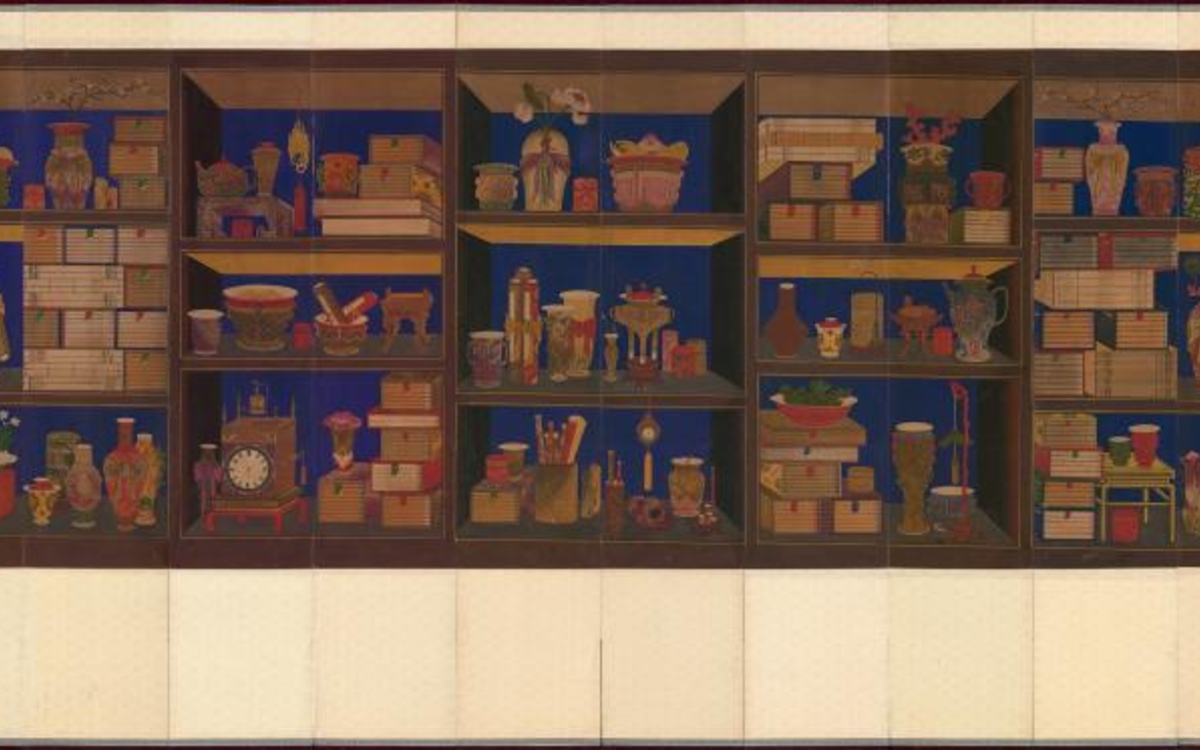
A fascinating deep dive into the discovery of a trompe-l'oeil art in Corée, between scholarly libraries and dreamlike worlds! Royal, academic or museum-related, the library remains a treasure trove of knowledge and escape. At the end of the 18th century in Corée, in the kingdom of Joseon, King Jeongjo (r. 1776-1800) found in the contemplation of a library painting a way to remain symbolically surrounded by his books: a trompe-l'oeil extending the spirit of the study room, stimulating virtue, curiosity and scholarly conversation. Jeongjo then entrusted the painters of the Académie royale with creating the first trompe-l'oeil library paintings, installed in his study or even behind his throne. The Korean embassies to Pékin then played a decisive role. The envoys of Joseon discovered there the Chinese treasure cabinets, as well as the Jesuit art of perspective, spread at the Qing court and in the churches of the imperial capital by European artists. The alliance between Chinese erudite accumulation and European trompe-l'oeil expertise nourished the inventiveness of Korean painters, who developed a singular use of perspective, the chaekgeori. Quickly, this new art of books and objects spread through the palaces, aristocratic residences and provincial households. Books, porcelains, archaizing bronzes, writing instruments or objects from Chine, Japon or the West accumulated there in a skillfully mastered play of optical illusions. Far from European vanitas, these painted libraries do not refer to real collections, but to a cabinet of desires, to what one aspires to possess one day. From the end of the 18th century, the book lost its scholarly value to become decorative; perspectives broke, forms distorted, fantastic animals appeared. The library moved away from reality to join a universe halfway between surrealism, fauvism and dreamlike imagination. For the first time at the musée Guimet, an exhibition restores to this pictorial movement its central place, far from the folkloric or purely decorative image too often associated with it. It weaves links between Jesuit art and Korean art, shows the impact of Korean embassies at the court of Chine, notably through an exceptional painted scroll of more than five meters from the 18th century presented for the first time, and reveals the diffusion of the codes of perspective thanks to works from the Louvre and the Asian Civilisation Museum de Singapour. It also demonstrates that Joseon Corée was the exact opposite of a "hermit kingdom" but rather an open, curious country, in constant dialogue with the world.
Source: Paris Open Data ↗