Galerie du Haut Pavé : Exposition de de Rendez-vous en Rendez-vous
Galerie du Haut Pavé
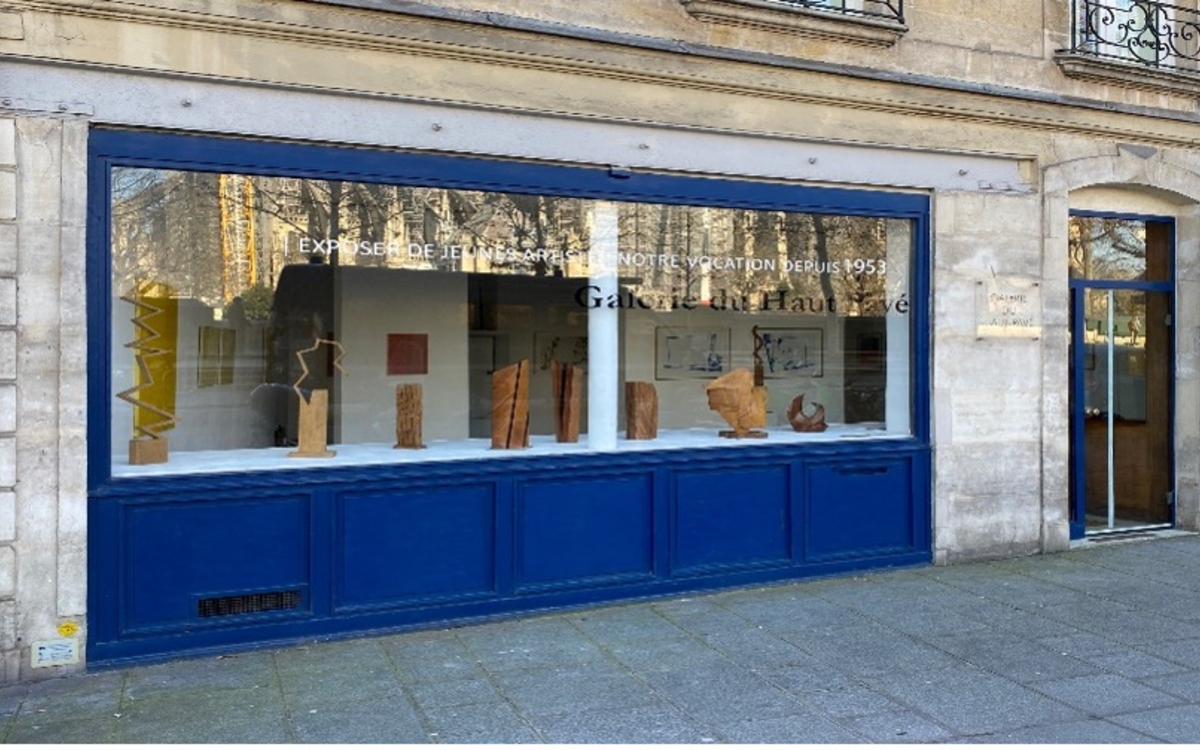
This Exhibition gives Artists who exhibited in previous years the opportunity for a second appointment. Vogel APACHETA: "What dilutes, what dissolves, in Vogel Apacheta's work, is form. One senses his pictorial sources in the vegetation and landscapes of his native country or elsewhere. They resurface in the form of fragments that seem to have been destructured, deconstructed, by a device similar to that of a kaleidoscope, with effects of mirror reflections, cleavage lines, foldings, false symmetries, collages and superpositions… We are here in a space of full freedom, in which the question of figuration or non-figuration does not arise. The resulting paintings thus resonate with another statement by Malraux, who wrote: "The conflict between figurative and non-figurative artists matters only for what was at stake, which was the painter's freedom (Pollock begins at Olympia…), even if it be the freedom to invent new figurations. It will not be abandoned anytime soon." Excerpt from the text by Louis Doucet, art critic, 2024 Jonathan BABLON: The evolution of the living and of societies are fields that Jonathan Bablon explored during his studies at the École des Beaux-Arts de Tours, which he completed in 2012. Since then, he has pursued a practice through the mediums of drawing, sculpture and installation. In 2013, following a residency in Kona, India, an initial approach to natural materials led him toward an ecological reflection that he came to develop with greater attention during a residency at Mode d'Emplois in 2014. After several exhibitions in art centers in France, he continued his artistic research through residencies (in 2022 at the Usine Utopik, in 2023 at the With Artist Foundation in Corée du Sud). Theoretical readings concerning the relationships between human culture and nature have nourished the artist's practice, in a search, through the field of visual arts, for a way to respond to contemporary and environmental current events. Aline DECROUEZ: Built according to a progressive and experimental approach, her practice deals essentially with questions related to color, with the color-space interaction, each spatial arrangement allowing her to play with different points of view according to new chromatic and formal devices. Whether assembled to form volumetric paintings or arranged separately in space to create surface, the monochromes she creates aim to question the forms of relationship that man maintains with his environment, mirroring perception into infinity. The viewer finds himself facing, and within, the expressiveness of color. Perception becomes experience. The viewer is led to act, to move, so that a point of view may appear: an overall perspective is then established, a "landscape"… The monochrome gives rise to a necessity for fragmentation and a form of organization. An imaginary realm takes shape wherever tensions arise. These tensions, which maintain a form of balance—internal tension and the tensioning of the different monochromes—form a whole. Painting as a listening to the visible. Rémy DUBIBE: Remy Dubibé is a nomad by upbringing, born in the emirates on the edge of the desert, raised in Indonesia by the water and the jungle. All the memories of this exotic childhood are found at the heart of his works: accumulations of small molded forms in clusters, suspensions or taut nets, whose whiteness and obsessive delicacy are nonetheless deceptive, in that they conceal a primitive harshness, a propensity for chaos. Capsules, shells, water lilies or origami foldings, smooth, softened, prickly or elliptical forms which, like ghosts or floating remnants of a world in decomposition, would recover, through swarming, concretion, proliferation or fragmentation, a "subtle savagery"… Marie Aimée FATTOUCHE: By conjugating infinity in the infinitive, Marie Aimée Fattouche invites an intimate wandering at the heart of this work of mechanical research that she began nearly two years ago. In this sanctuarized space deliberately inspired by the hypostyle halls of the Egypt of her origins, these strange columns and architectures which rise or lie on the ground, when they are not truncated and threatened with ruin, seem to bear witness to a mysterious transcendence. All obey the same principle, elevated to a system: two pieces of clay, a key and a double latch, each hand-shaped, which fit together mechanically, weaving through their assemblage a network as solid as it is supple, yet never free from risk. In this paradoxical duality intimately experienced by the artist, in the infinite repetition of the assembling gesture, in the vertigo of the void around which the work organizes itself and draws its coherence, lies the very essence of the creative endeavor. A wager, a promise, a prayer. Pascale Richard Sarah KRESPIN: Sarah Krespin, in her woven sculptures, her Mutations, apparently soft, echoes the uncertainties and fears of our time. Neither frozen nor free, but as if caught in convulsive spasms, they draw from all three kingdoms: mineral, vegetable and animal. From her training at the École Duperré, she has retained a tropism for fabric, supple yet rigidified through the use of a copper wire frame that fixes its shape and makes it the memorial monument of a unique, non-reproducible gesture which, even if she wanted to repeat it, would not produce similar results. […] Antoine LANGENIEUX: His painting practice rests on two fundamental points: surface as a site to be constructed and the technical device from which form emerges. Through different methods of assembly and folding, he thinks about gesture and its anchoring in the canvas. He seeks strategies that push into the background the role of
Source: Paris Open Data ↗