Monet, peindre le temps
Musée de l'Orangerie
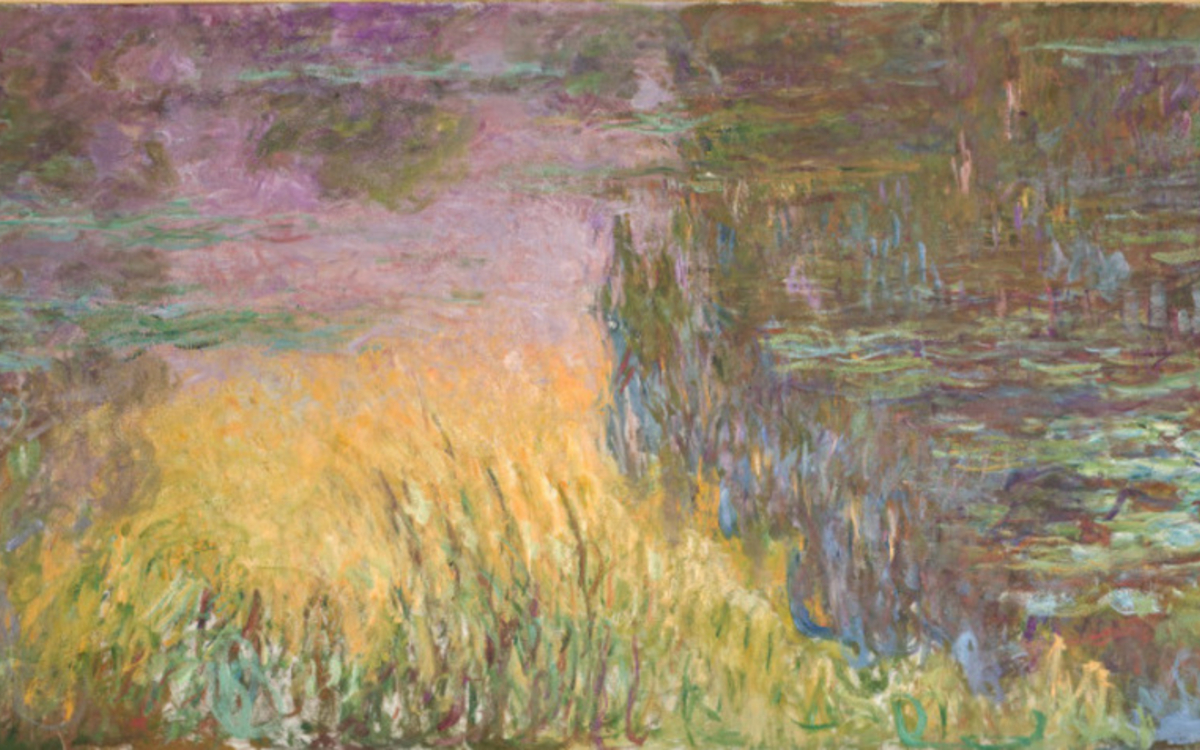
The year 2026 will mark the centenary of the death of the painter Claude Monet (1840-1926). To commemorate this anniversary, the musée de l'Orangerie is organizing an exhibition focused on the relationship between Monet's work and time. From the 1870s onward, he was considered the quintessential Impressionist artist, even though he took part in only five of the group's exhibitions. His work quickly came to be identified with the "new painting," so much did it embody its characteristics (most often executed outdoors, with a rapid touch and clear harmonies revealing the impression of a moment), before leading to one of its most singular and remarkable extensions. In the 1890s, with series such as Les cathédrales, Les meules, Les peupliers, the painter reveals an approach akin to the dissection of time, up to the final testament of the Nymphéas, which resolves this insurmountable difficulty of fragmentation in the series by merging into the continuum. A selection of nearly forty paintings by Monet, coming mainly from the collections of the musée d'Orsay and the musée Marmottan Monet, but also from loans from French and international public and private collections, will highlight these different moments while dwelling more particularly on the Nymphéas cycle. From this unprecedented angle and with a detached perspective drawing on different fields of research, the exhibition will offer a re-examination of a body of work whose significance, a hundred years later, remains more fundamental than ever. The exhibition naturally finds its place at the musée de l'Orangerie, which houses the great decorations of the Nymphéas. This unique ensemble, a veritable "Sistine Chapel of Impressionism," according to the expression used by André Masson in 1952, offers a testimony to the work of the late Monet, conceived as a genuine environment and crowning the Nymphéas cycle. The exhibition invites reflection on the feeling of accelerating time and modernity during the artist's Impressionist period, on the capturing of instantaneity through series, and finally on the Nymphéas cycle, in its quest to transcribe duration. Monet develops a form of painting that responds to the challenges and upheavals of his era regarding the notion of time, from a point of view that is both lived and felt, but also tangible through the concrete signs of transformation of urban space and landscape. The 19th century is one of the proliferation of clocks in public space and the synchronization of measured time; it is also that of the transport revolution and the development of railways. The Impressionist moment in Monet's work thus appears, echoing this revolution in the understanding of time in the 19th century, as that of a painting that seeks to inscribe itself ever more within instantaneity. After the years during which the Impressionist exhibitions took place, one notices in the artist a tendency to explore the effects produced at different times of day on the same subject. It is in Normandy that he finally develops his famous series around Les Meules, (1888-1891), Les Peupliers au bord de l'Epte (1891-1892), Matinée sur la Seine (1896-1897), as well as around the Cathédrale de Rouen (1892-1898). Through these series, the painter pushes the logic of representing the moment to the point of fragmenting time in order to better grasp its essence. In 1895, the Cathédrales de Rouen exhibited at Durand-Ruel amounted, for Clemenceau, to "a revolution without a shot fired" (Clemenceau, "Révolution de Cathédrales" in 1895 in La Justice). Through these pictorial investigations, Monet seems to partake in his era's fascination with the meticulous and almost scientific observation of the surrounding world. In the 1890s, Monet inaugurated the final cycle that would occupy him until his death in 1926, that of the Nymphéas. It comprises more than two hundred and fifty canvases devoted to the same subject and is crowned by the creation of the two rooms designed specifically to house his great panels, offered to France in the aftermath of the 1918 armistice, the painter's ultimate work, inaugurated a year after his death in 1927. Everything conspires to offer the viewer an immersion within the work akin to duration in the Bergsonian sense of the term.
Source: Paris Open Data ↗