Musée de la musique - Collection permanente
Philharmonie de Paris
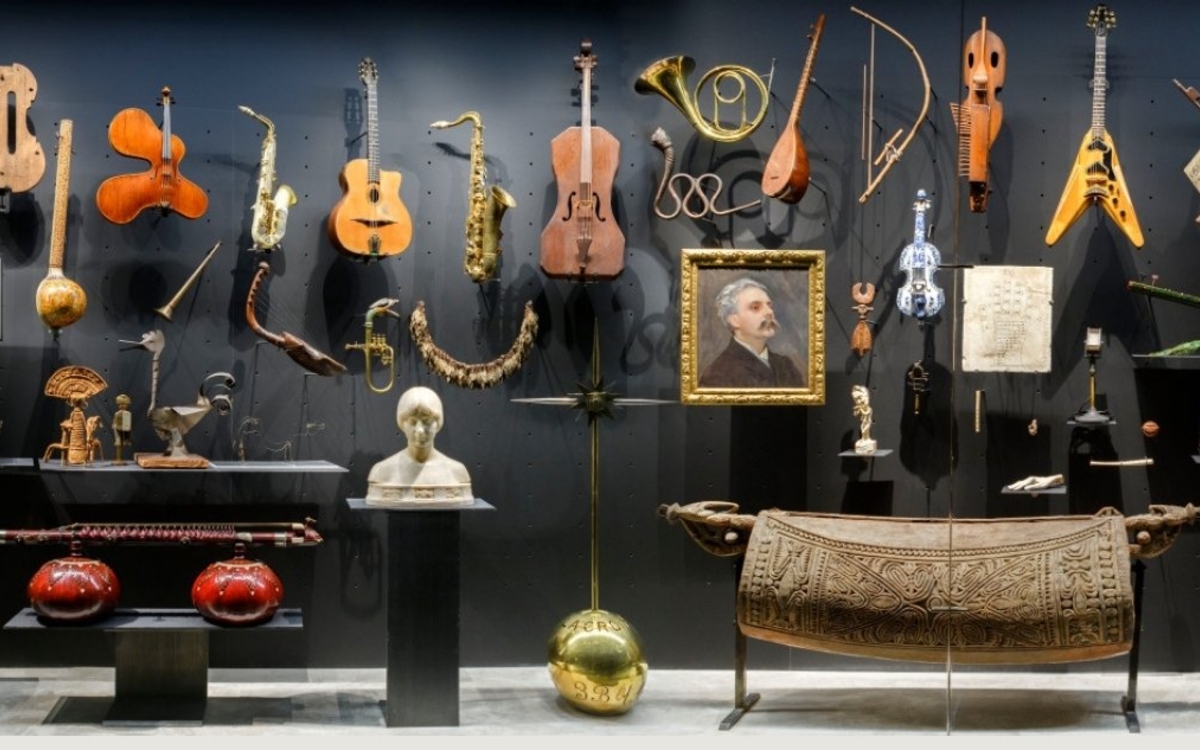
To mark the 30th anniversary of the Cité de la musique and the 10th anniversary of the Philharmonie in 2025, the Musée unveils the new presentation of its collection. More inclusive, the museography favors reconnecting musical heritages from around the world, while highlighting their historical evolutions and contemporary dynamics. A national museum with a rich collection of nearly 9,000 instruments and works of art, the Musée de la musique is fully part of the daily life of the Philharmonie, whose heritage ambition it nourishes. The Musée indeed preserves one of the most important collections of instruments in the world, both in terms of rarity and diversity of objects. The Musée's new itinerary unfolds a vast history of music around the world, from the end of the 16th century to the present day. The collection illustrates the musical "modernity" explored in Europe, from the Renaissance to contemporary and electronic experiments. It highlights, in parallel, the richness and vitality of the musical cultures of Asia, Africa, Oceania and the Americas. With this new, more inclusive museography, the itinerary favors the reconnection of musical heritages around the world, while illustrating their historical evolutions and contemporary dynamics. The scenography includes multimedia devices. A musician, present every day in the Musée, brings this itinerary to life. He plays, talks about his instrument and exchanges with the public. During the concert-walks or musical tales organized on Sunday afternoons, all the spaces buzz with words and sounds. At any time, a visit to the Musée, open to all, young and old, is a true musical experience! Polyphonie The itinerary begins with a vast cabinet of curiosities, celebrating the diversity of the Musée's collection. Musical instruments from multiple eras and of all origins sit alongside paintings, sculptures, or luthier's tools. These objects are remarkable for the craftsmanship of their makers, their unusual shapes or decorations, their belonging to personalities of the musical world or their historical importance. Musique et pouvoir In the 17th century, from Mantua to Versailles, as well as in Northern India or the Ottoman Empire, a refined court music developed in the service of sovereigns. The model of the hall of the palace of Mantua evokes the 1607 performance of L'Orfeo by Claudio Monteverdi, considered the first opera in history. A unique collection of instruments bears witness to the musical practices of the time: keyboards, lutes, cornetts, cittterns… At the château de Versailles, Louis XIV fostered the flourishing of baroque music. At the same time, the worlds of art, and particularly that of instrument making, benefited from the expansion of trade routes linking the continents. Motifs and materials circulated just as much as objects: ivory, ebony, mother-of-pearl or tortoiseshell are found on European viols and guitars as well as on the prestigious instruments of the Mughal courts. L'imaginaire des Lumières In the 18th century, in France, music gradually left the court. The salons of aristocrats and cultivated bourgeois fostered the rise of instrumental music. There, one played the harpsichord, the harp… The era was also marked by an idealized vision of nature, which gave rise, within cultivated societies, to a vogue for pastoral music. The decorative styles of "africanerie," "chinoiseries," and the musical style "alla turca" emerged in a context of exploration, trade exchanges but also slavery. The evolution of musical taste toward greater expressiveness favored the appearance of a new instrument, the piano-forte. Public concerts developed, including those of the Concert Spirituel, welcoming renowned foreign musicians such as Joseph Haydn and Wolfgang Amadeus Mozart. L'Empire de la musique The violin, which occupies a central place in the repertoire and the European classical orchestra, traveled and spread to every continent. A double display case honors its transcultural history, and celebrates the violins by Antonio Stradivari preserved at the Musée. The playing of the soloist and the rise of the symphony orchestra constitute the two poles of instrumental music in 19th-century Europe. Driven by the growing needs, in terms of timbre and power, of orchestras—particularly those of Hector Berlioz and Richard Wagner—new instruments emerged: the octobasse, the saxophone, the Wagner tuba… The composers and virtuoso pianists Franz Liszt and Frédéric Chopin, linked to the piano makers Érard and Pleyel, embody the figure of the Romantic musician. Orientalism made its appearance, notably in opera, where orientally-inspired sonorities were highlighted by spectacular sets and costumes. Explorer l'inouï The work Ionisation (1931) by Edgard Varèse illustrates how percussion opened up an unprecedented sound field in the 20th century, as new musical languages were invented. The advent of electricity also revolutionized music with the invention of new instruments, notably by Léon Theremin, Maurice Martenot or Laurens Hammond. The technological upheaval of analog and then digital tools is represented at the Musée by the console 116 C of the Groupe de Recherche Musicale, the Upic machine by Iannis Xenakis, or the 4X computer developed by Ircam. Popular music fully benefited from these technical revolutions. At the same time, the rise of recording and globalization fostered access to music from other regions of the globe, from Russian folklore to Javanese gamelan. A gallery devoted to the electric guitar presents legendary models of guitars and basses by Fender, Gibson or Rickenbacker. Des musiques et des mondes The crowning achievement of the Musée's renovation, the final space renews the exhibitio
Source: Paris Open Data ↗