Soleil et Lune. Andreas Eriksson en dialogue avec Ivan Aguéli
Institut suédois
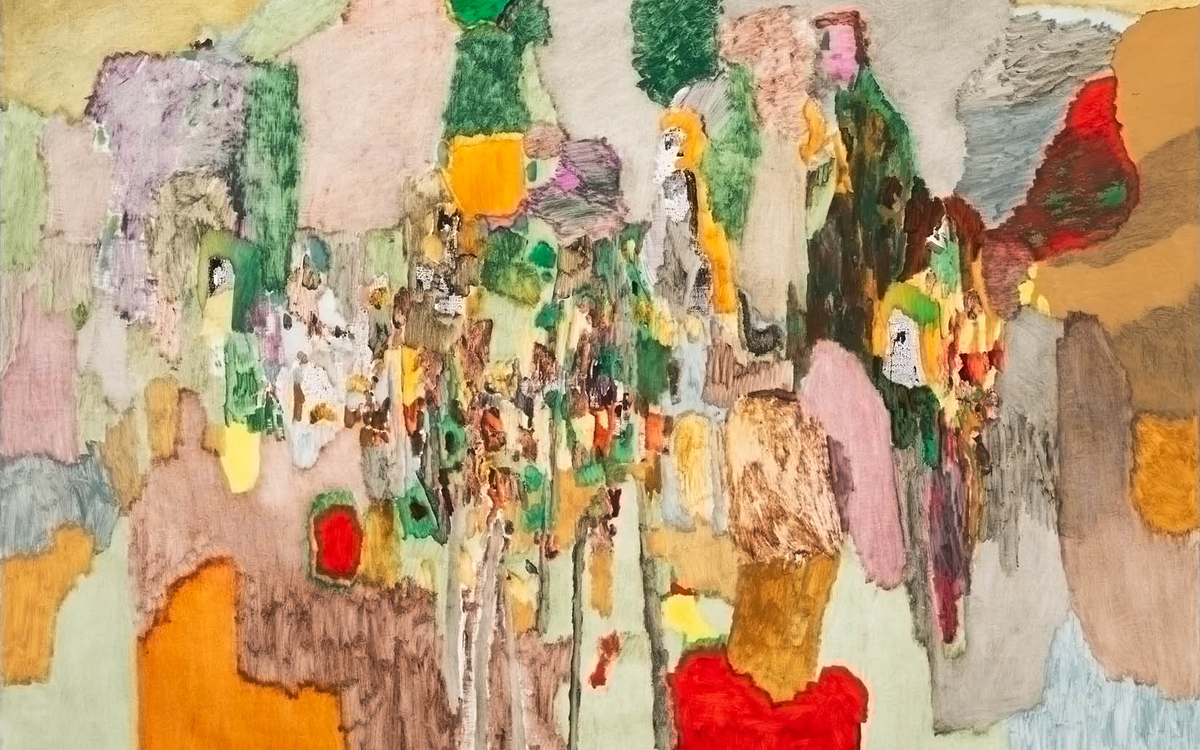
The Institut suédois devotes its autumn exhibition to Andreas Eriksson (born in 1975), a major figure on the contemporary art scene. His meditative work, in earthy and vegetal tones, is set alongside that of Ivan Aguéli (1869 – 1917), artist, thinker and great traveller. Andreas Eriksson builds visual structures by means of blocks, layers and strokes of paint, which can be interpreted as so many ways of experiencing the world. Geological strata, minerals, moss, leaves or bark… His paintings are superimpositions of materiality, accumulations of energy and time in varied densities and forms. His art is fundamentally tied to one single place: Medelplana, at the foot of the Kinnekulle plateau, in south-western Sweden, near Lake Vänern. The earthy, saturated colours of his paintings come from the landscapes surrounding his house and make up his daily life. Facing Andreas Eriksson's monumental paintings are exhibited about ten small-format works by Ivan Aguéli, painter and mystic who died at the beginning of the last century. Their reduced size indicates a movement: these works were made along the paths that led him far from his native Sala – a small mining town located in a mountainous region of central Sweden. The landscapes evoke the south; they are sun-bleached, luminous, their forms reduced and simplified, almost cubist, as if painted hastily, with fervour. Ivan Aguéli's works were selected by Andreas Eriksson, who wished to give them a place in their own right within his exhibition. In their palette, their motifs, their atmosphere and their approach, the works of the two artists are almost opposites. Aguéli's blazing light and vast skies; Eriksson's dark, mineral earth. Ivan Aguéli held the conviction that art could be a portal towards a higher truth. His entire life was an unceasing quest, driven by various spiritual, political and aesthetic doctrines. A journey which, from Sala, led him towards horizons as distant as Paris and Cairo. From the Lutheran Protestantism of his childhood to the mysticism of Swedenborg, and from anarchism to the esoteric Islam of the Sufi tradition. At first glance, one might think that the differences between the two artists could not be greater. Ivan Aguéli, the anarchist, the Sufi, whose vagabond life in search of wisdom led him to a premature death, in extreme destitution. And Andreas Eriksson, whose art is born of a single place. One in perpetual movement, the other having made stillness a necessary condition for painting. But seeing their works side by side, the biographical differences seem to fade. The presence of the sensible is what unites them. Earth, stones, trees in Andreas Eriksson's work; sky, sun and light in Ivan Aguéli's. These paintings live within the same atmosphere and answer to a shared quest for truth. Alongside the exhibition, a book presents the works of the two artists in mirrored fashion. With a text by Sara Arrhenius.
Source: Paris Open Data ↗